Watch the full episode. See more NOW on PBS.
Monday, November 22, 2010

Wednesday, November 17, 2010
Thursday, November 11, 2010
Tuesday, November 9, 2010
Swan Dive 3
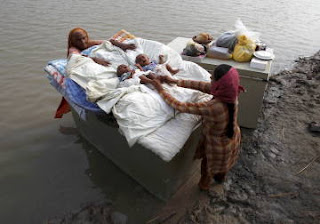
I am and aim to be in middles of the storm;
when it comes and carries and takes me I will have been of you and with it;
together we will have been more and less affected by the floods.
I am so far away, from myself, now,
speaking as if I wasn't living!
While I live, it is a storm I aim to be; a middle.
Paradise blows through my teeth!
Rubbish barrels out of me,
Barrels and barrels of fossils go
into making me, and I am a living
consuming being,
being consumed.
when it comes and carries and takes me I will have been of you and with it;
together we will have been more and less affected by the floods.

I am so far away, from myself, now,
speaking as if I wasn't living!
While I live, it is a storm I aim to be; a middle.
Paradise blows through my teeth!
Rubbish barrels out of me,
Barrels and barrels of fossils go
into making me, and I am a living
consuming being,
being consumed.
Swan Dive 2
It is crucial that the angel of history can only see behind us.
Were it able to see now, fully
it would lose its instincts;
the wind would cease to feel on its wings.
Okay, stranger: the breeze has blown us together.
My childhood, now, spins away from me;
You and my childhood spin toward and away from me.
It is never not spinning; tho we tweet and tweet
(the birds themselves tweet! and I do know you)
and tweets themselves proceed from now to backwards, changing
our experience of reading (from up to down
to down to up)...
the breeze is blowing and piling everything up and up.

Were it able to see now, fully
it would lose its instincts;
the wind would cease to feel on its wings.
Okay, stranger: the breeze has blown us together.
My childhood, now, spins away from me;
You and my childhood spin toward and away from me.

It is never not spinning; tho we tweet and tweet
(the birds themselves tweet! and I do know you)
and tweets themselves proceed from now to backwards, changing
our experience of reading (from up to down
to down to up)...
the breeze is blowing and piling everything up and up.


Wednesday, November 3, 2010
Swan Dive
Poems play with our expectations. That is why we read them: to get played.
One line subverts
another: a beach becomes
a log becomes
a kitchen. The poem
builds the kitchen. Swan dive.
A man in a hot tub
riding a motorcycle, holding
a bottle of Old Spice, reading.
The logic of the commercial
is a similar logic to many contemporary American poems today, such as this Heather Christle poem. Compare.
(Look at the Heather Christle poem. Now back to me. Now back to the Heather Christle poem.)
In this case, the Old Spice Man is a forest.
Objects (and setting) swirl and mutate around
it; meaningless and meaningful and intelligible; instinctive;
neural-pathway-forming (and diverting). What is
the core of the poem? Where does the poem stand?
What does it stand for? Where does it move? What about the advertisement?
Is the ad an ad for Old Spice or for masculinity?
Is it a joke on masculinity? Does it work?
Is it a poem?
Similarly, is Christle's poem a joke on culture, or on nature?
A joke on deforesters, or tree-huggers? On me? You?
Is it an advertisement? (Do you want new windows, reader?)
Or do you want to be clean? (I make phone calls for a candidate
who refuses corporate donations over the weekend,
and am advised not to refer to the other, leading candidate;
even a mention of his name increases his chances
of victory.) What are we putting in circulation?
What new pathways do we want to create?
Every poem, and advertisement
answers this, whether it wants to or not.
This seems to be a problem, for poetry.
Still, it can enter the battle in the middle of the fray
or build up new networks from the margins
or build up new networks from the margins of the middle of the fray.
Poetry can divert us from pathways,
change pathways to take us
onto other pathways. "Verse": meaning
the turn
at the end of the row
when plowing. (Might this agricultural remnant
signal a direction for our attention?) Link
to link to link.
Consider what I find
when googling "Old Spice Man" and "poetry".
This cannot help but send me spiraling into 200 other video responses
(are these poems?), not to mention Greg Oden's blog
(these?) and now I'm back to Kanye's tweets,
which certainly play with my expectations.
(Or have I lost you out there, and are you now already spiraling?)
1. There's a layer of... Entertainment... we are entertainers and this is only TV... not the War 9:25 AM Sep 4th via web
2. There's a layer of... hey Kanye said what I was thinking 9:23 AM Sep 4th via web
3. A year later where do we stand? 9:22 AM Sep 4th via web
4. WHO BENEFITED FOR REAL PEOPLE???!!!!!!!! 9:21 AM Sep 4th via web
5. Walk with me people... let's break this down for real now. I might get in trouble again lol? 9:20 AM Sep 4th via web
6. MTV? JAY LENO? BEYONCE? ALL FORMS OF MEDIA? TAYLOR? KANYE WEST? Who gained? Who lost? 9:19 AM Sep 4th via web
7. You've got the Media play... Who benefitted off of the moment? 9:16 AM Sep 4th via web
I do not expect this, from a celebrity!
(I expect a celebrity; that is why I go online and surf through junk
and poetry...) The amount, and directness
and style of the tweets is unexpected! Kanye West
is a poet?
He speaks truths. (Not truth to power,
but power away from untruth?)
Conclusion: our celebrities are our poets?
They have our attention and direct
or redirect it daily.
If there are poems, today, they are an advertisement, spoken by a celebrity, away from untruth. They are the rerouting
of power and of untruth; the plowing and replowing of pathways...
(Not row to row, but link to link to link...)
“Hello, ladies. Look at your poem, now back to me, now back at your poem, now back to me. Sadly, it isn’t me, but if it stopped sounding like a poem and switched to me, it could smell like it’s me. Look down, back up, where are you? You’re on a boat with the poem your poem could smell like. What’s in your hand, back at me. I have it, it’s an oyster with two tickets to that thing you love. Look again, the tickets are now diamonds. Anything is possible when your poem smells like South Africa. I’m on a horse.”
What cruel, twisted creek would our great moral writers of the past find us up!
(In their time, too, atrocity was all around them, and yet they wrote and wrote and wrote.)
What paddles would they have to give us?
What if it wasn't cruel?
I take my paddle from Kanye;
He manufactures paddles daily with his throat.
His fingers fiddle away at pathways;
I wish to be a jumbo paddle up his throat.
Workers fiddle away at pathways;
I am a culture worker whose hook is in my throat.
The great moral writers of the past might sense our situation;
they would be of our situation, utterly, and sense
how to correctly intervene
in time.
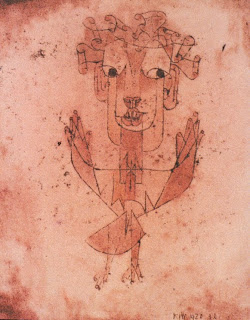
IX. A Klee painting named ‘Angelus Novus’ shows an angel looking as though he is about to move away from something he is fixedly contemplating. His eyes are staring, his mouth is open, his wings are spread. This is how one pictures the angel of history. His face is turned toward the past. Where we perceive a chain of events, he sees one single catastrophe which keeps piling wreckage and hurls it in front of his feet. The angel would like to stay, awaken the dead, and make whole what has been smashed. But a storm is blowing in from Paradise; it has got caught in his wings with such a violence that the angel can no longer close them. The storm irresistibly propels him into the future to which his back is turned, while the pile of debris before him grows skyward. This storm is what we call progress. (Walter Benjamin)
1. There's a layer of... Entertainment... we are entertainers and this is only TV... not the War 9:25 AM Sep 4th via web
2. There's a layer of... hey Kanye said what I was thinking 9:23 AM Sep 4th via web
3. A year later where do we stand? 9:22 AM Sep 4th via web
4. WHO BENEFITED FOR REAL PEOPLE???!!!!!!!! 9:21 AM Sep 4th via web
Should we use Old Spice Body Wash?
You tell me.
I can only see behind us.
One line subverts
another: a beach becomes
a log becomes
a kitchen. The poem
builds the kitchen. Swan dive.
A man in a hot tub
riding a motorcycle, holding
a bottle of Old Spice, reading.
The logic of the commercial
is a similar logic to many contemporary American poems today, such as this Heather Christle poem. Compare.
(Look at the Heather Christle poem. Now back to me. Now back to the Heather Christle poem.)
In this case, the Old Spice Man is a forest.
Objects (and setting) swirl and mutate around
it; meaningless and meaningful and intelligible; instinctive;
neural-pathway-forming (and diverting). What is
the core of the poem? Where does the poem stand?
What does it stand for? Where does it move? What about the advertisement?
Is the ad an ad for Old Spice or for masculinity?
Is it a joke on masculinity? Does it work?
Is it a poem?
Similarly, is Christle's poem a joke on culture, or on nature?
A joke on deforesters, or tree-huggers? On me? You?
Is it an advertisement? (Do you want new windows, reader?)
Or do you want to be clean? (I make phone calls for a candidate
who refuses corporate donations over the weekend,
and am advised not to refer to the other, leading candidate;
even a mention of his name increases his chances
of victory.) What are we putting in circulation?
What new pathways do we want to create?
Every poem, and advertisement
answers this, whether it wants to or not.
This seems to be a problem, for poetry.
Still, it can enter the battle in the middle of the fray
or build up new networks from the margins
or build up new networks from the margins of the middle of the fray.
Poetry can divert us from pathways,
change pathways to take us
onto other pathways. "Verse": meaning
the turn
at the end of the row
when plowing. (Might this agricultural remnant
signal a direction for our attention?) Link
to link to link.
Consider what I find
when googling "Old Spice Man" and "poetry".
This cannot help but send me spiraling into 200 other video responses
(are these poems?), not to mention Greg Oden's blog
(these?) and now I'm back to Kanye's tweets,
which certainly play with my expectations.
(Or have I lost you out there, and are you now already spiraling?)
1. There's a layer of... Entertainment... we are entertainers and this is only TV... not the War 9:25 AM Sep 4th via web
2. There's a layer of... hey Kanye said what I was thinking 9:23 AM Sep 4th via web
3. A year later where do we stand? 9:22 AM Sep 4th via web
4. WHO BENEFITED FOR REAL PEOPLE???!!!!!!!! 9:21 AM Sep 4th via web
5. Walk with me people... let's break this down for real now. I might get in trouble again lol? 9:20 AM Sep 4th via web
6. MTV? JAY LENO? BEYONCE? ALL FORMS OF MEDIA? TAYLOR? KANYE WEST? Who gained? Who lost? 9:19 AM Sep 4th via web
7. You've got the Media play... Who benefitted off of the moment? 9:16 AM Sep 4th via web
I do not expect this, from a celebrity!
(I expect a celebrity; that is why I go online and surf through junk
and poetry...) The amount, and directness
and style of the tweets is unexpected! Kanye West
is a poet?
He speaks truths. (Not truth to power,
but power away from untruth?)
Conclusion: our celebrities are our poets?
They have our attention and direct
or redirect it daily.
If there are poems, today, they are an advertisement, spoken by a celebrity, away from untruth. They are the rerouting
of power and of untruth; the plowing and replowing of pathways...
(Not row to row, but link to link to link...)
“Hello, ladies. Look at your poem, now back to me, now back at your poem, now back to me. Sadly, it isn’t me, but if it stopped sounding like a poem and switched to me, it could smell like it’s me. Look down, back up, where are you? You’re on a boat with the poem your poem could smell like. What’s in your hand, back at me. I have it, it’s an oyster with two tickets to that thing you love. Look again, the tickets are now diamonds. Anything is possible when your poem smells like South Africa. I’m on a horse.”
What cruel, twisted creek would our great moral writers of the past find us up!
(In their time, too, atrocity was all around them, and yet they wrote and wrote and wrote.)
What paddles would they have to give us?
What if it wasn't cruel?
I take my paddle from Kanye;
He manufactures paddles daily with his throat.
His fingers fiddle away at pathways;
I wish to be a jumbo paddle up his throat.
Workers fiddle away at pathways;
I am a culture worker whose hook is in my throat.
The great moral writers of the past might sense our situation;
they would be of our situation, utterly, and sense
how to correctly intervene
in time.
IX. A Klee painting named ‘Angelus Novus’ shows an angel looking as though he is about to move away from something he is fixedly contemplating. His eyes are staring, his mouth is open, his wings are spread. This is how one pictures the angel of history. His face is turned toward the past. Where we perceive a chain of events, he sees one single catastrophe which keeps piling wreckage and hurls it in front of his feet. The angel would like to stay, awaken the dead, and make whole what has been smashed. But a storm is blowing in from Paradise; it has got caught in his wings with such a violence that the angel can no longer close them. The storm irresistibly propels him into the future to which his back is turned, while the pile of debris before him grows skyward. This storm is what we call progress. (Walter Benjamin)
1. There's a layer of... Entertainment... we are entertainers and this is only TV... not the War 9:25 AM Sep 4th via web
2. There's a layer of... hey Kanye said what I was thinking 9:23 AM Sep 4th via web
3. A year later where do we stand? 9:22 AM Sep 4th via web
4. WHO BENEFITED FOR REAL PEOPLE???!!!!!!!! 9:21 AM Sep 4th via web
Should we use Old Spice Body Wash?
You tell me.
I can only see behind us.

Tuesday, November 2, 2010
Fast Poetry
Parallel to the piece on Flarf (part 3 of 5 in my series on contemporary poetry in The Atlantic), I'll be running some more speculative posts here on the blog this week, about what it means to write poetry in high-speed, meme (and capital) driven culture.
Swan Dive.
Swan Dive.
Wednesday, October 27, 2010
Tuesday, October 26, 2010
Friday, October 22, 2010
Links re: Accessibility in poetry
Getting a lot of great stuff sent my way through this Atlantic article—here's a few great links I just got sent (thanks to Kristin Esch down at The Poetry Foundation).
- Matthew Zapruder points to how it should be a critic's responsibility to 'clarify a reading experience': "What is the purpose of literary criticism? Among other things, to guide the reader past his or her resistance." (www.poetryfoundation.org/journal/article.html?id=186047)
- Dan Chiasson recommends an accessible poet that "you could recommend to your cousin at a barbeque and, the next day, teach in a seminar for majors" (http://www.poetryfoundation.org/journal/article.html?id=178562)
- June Jordan ruminates on the 'inaccessible' canon: "Trying to understand the system responsible for every boring, inaccessible, irrelevant, derivative and pretentious poem that is glued to the marrow of required readings in American classrooms, or trying to understand the system responsible for the exclusion of every hilarious, amazing, visionary, pertinent and unforgettable poet from National Endowment of the Arts grants and from national publications, I come back to Walt Whitman." (www.poetryfoundation.org/journal/article.html?id=178489)
Wednesday, October 20, 2010
"The Righteous Skeptic's Guide to Reading Poetry"
Part 1 of a 5 part series I'm doing for The Atlantic on contemporary poetry.
Monday, October 18, 2010
Zizek on Democracy Now
"we, the leftists, we have no right to have this arrogant view that intolerant people [anti-immigrationists in Germany; Tea Party here] are horrible...we should ask the question how we enable it"
Questioning Audience in "New American Poets": A Public Space
In his intro to some "New American Poets" in Issue 11 of A Public Space, Stephen Burt asks, "When we ask how to connect a poem to an idea about poetry in general, we are also asking about an implied author, and about her implied audience. For whom, and to whom, does each poet write?"
It's good to hear Burt contextualizing his usually-perceptive questions about speaker with regard to audience. For about forty years now, poets and critics have built bodies of work on ideas about "speaker" (whether slippery or stable). It seems to me that this focus on speaker has overshadowed more urgent rhetorical issues, and that it has also run parallel to the overshadowing of the commons in practically every other arena (from the privatization of the amount of carbon in the sky to the privatization of the human genome). It makes sense that our (poems'; poets') civic antennae would be eroded in an era like this one; it makes sense, now, that we might want to rehabilitate them.
Burt begins with the seemingly solid fact that "good poems try to be as unlike one another as possible," and "We do not want poems to be wholly like one another—we take an interest in how they diverge—for the same reasons that we do not want our friends, our acquaintances, to be too much alike" (78). But what if this quest for "being-unlike" (rather than being-differently-with/within) mirrors all too perfectly the 'consumer choice' ideology of the 90's and 2000's? Are these poems offering, in fact, very similar choices, marketed (like brands) under the banner of individualistic difference?
In light of their "imagined audience," it seems to me that the representative poems are still, somehow, VERY akin to each other. Not wanting poems to be "wholly" like one another seems a world away from saying that "good poems try to be as unlike one another as possible." And like or unlike each other in what ways?
If the even "very good" poems in this selection produce difference at the levels Burt identifies—what fundamental sameness might be going unnoticed? (Not whether the poet eats toast or oatmeal or nasi goreng for breakfast, but whether the poem, for the reader, is toast, or oatmeal, or nasi goreng?)
What would great poems do?
*
Burt is absolutely right to suggest that, if the poem "works as an individual poem, it will at once prompt, and frustrate, the best answers we can give."
But what if the poem wants to work, not as an individual poem, but as part of a kind of commons?
In other words: what are the questions?
It's good to hear Burt contextualizing his usually-perceptive questions about speaker with regard to audience. For about forty years now, poets and critics have built bodies of work on ideas about "speaker" (whether slippery or stable). It seems to me that this focus on speaker has overshadowed more urgent rhetorical issues, and that it has also run parallel to the overshadowing of the commons in practically every other arena (from the privatization of the amount of carbon in the sky to the privatization of the human genome). It makes sense that our (poems'; poets') civic antennae would be eroded in an era like this one; it makes sense, now, that we might want to rehabilitate them.
Burt begins with the seemingly solid fact that "good poems try to be as unlike one another as possible," and "We do not want poems to be wholly like one another—we take an interest in how they diverge—for the same reasons that we do not want our friends, our acquaintances, to be too much alike" (78). But what if this quest for "being-unlike" (rather than being-differently-with/within) mirrors all too perfectly the 'consumer choice' ideology of the 90's and 2000's? Are these poems offering, in fact, very similar choices, marketed (like brands) under the banner of individualistic difference?
In light of their "imagined audience," it seems to me that the representative poems are still, somehow, VERY akin to each other. Not wanting poems to be "wholly" like one another seems a world away from saying that "good poems try to be as unlike one another as possible." And like or unlike each other in what ways?
If the even "very good" poems in this selection produce difference at the levels Burt identifies—what fundamental sameness might be going unnoticed? (Not whether the poet eats toast or oatmeal or nasi goreng for breakfast, but whether the poem, for the reader, is toast, or oatmeal, or nasi goreng?)
What would great poems do?
*
Burt is absolutely right to suggest that, if the poem "works as an individual poem, it will at once prompt, and frustrate, the best answers we can give."
But what if the poem wants to work, not as an individual poem, but as part of a kind of commons?
In other words: what are the questions?
Subscribe to:
Posts (Atom)